

Introduction
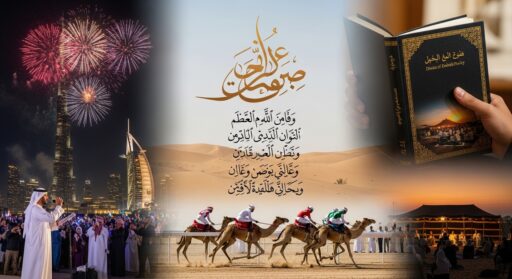
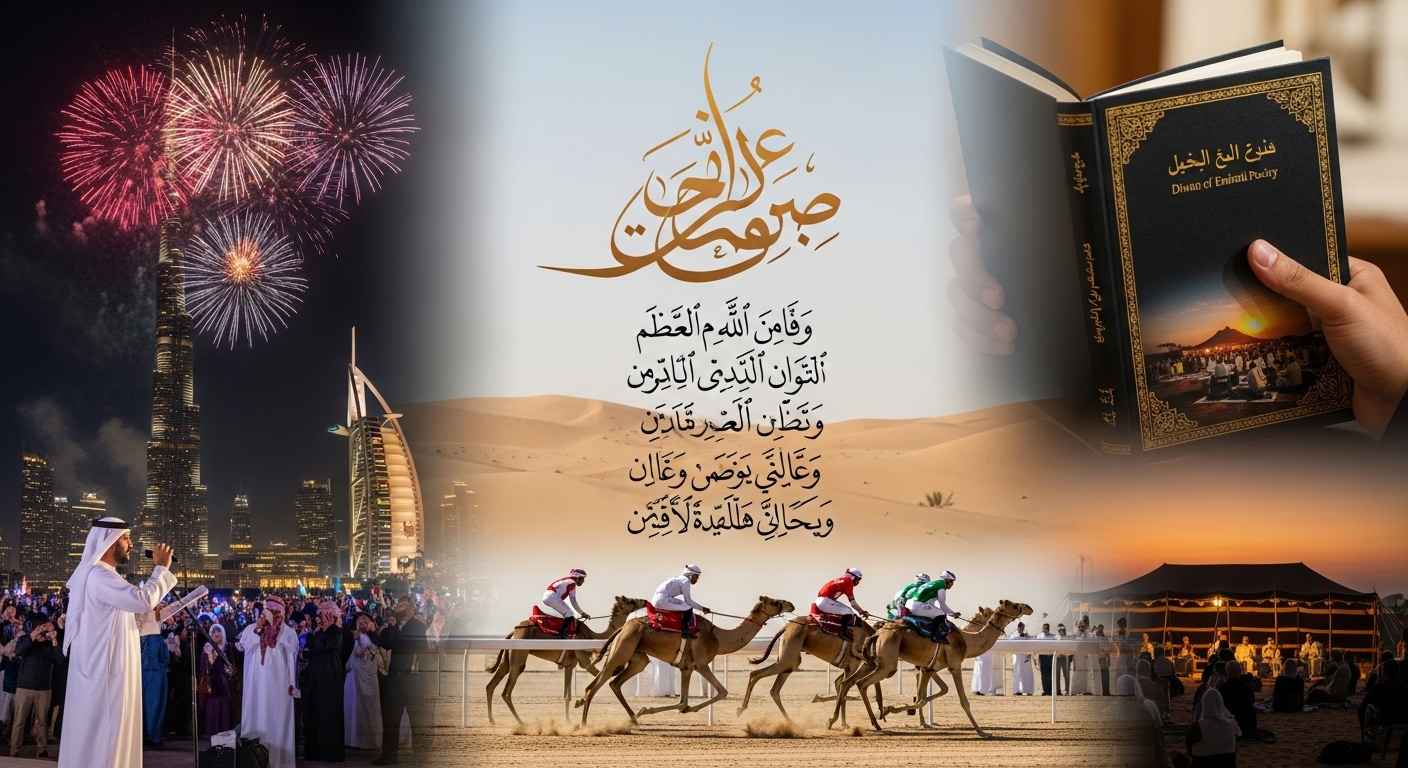
In the United Arab Emirates, poetry is not confined to books or quiet gatherings; it is a vibrant, public art form that gives voice to the nation’s most joyous celebrations. From the thrilling excitement of camel races to the profound unity felt on National Day, verse provides the rhythmic heartbeat and eloquent expression of collective joy. Poetry transforms these events from mere occasions into deeply meaningful cultural rituals, linking modern festivities to an ancient tradition of public performance.
History
The integration of poetry into celebration is a tradition as old as the Bedouin culture itself. Historically, any significant communal event—a victorious battle, a wedding, the return of a pearling fleet, or a successful harvest—was marked by poetic recitation. Poets would spontaneously compose verses to commemorate the event, praising the heroes, describing the action, and encapsulating the community’s emotions. These poems would then be memorized and repeated, becoming the official, lyrical record of the celebration. Camel racing, a sport with deep historical roots, was always accompanied by poets who would recite verses celebrating the speed and pedigree of the prized animals.
Key Features
The poetry of celebration is characterized by its themes of praise, joy, unity, and pride. Its language is often elevated and passionate, designed to stir the emotions of the audience. During camel races, the poems are typically short, rhythmic, and energetic, matching the pace of the event. For National Day, the poems are more reflective and grand, focusing on themes of nationhood, sacrifice, and the vision of the founding fathers. A key feature is its public and performative nature; it is meant to be heard by a crowd, often delivered with a distinctive, chanting cadence that enhances its emotional impact.
Cultural Significance
The role of poetry in celebrations is to articulate what the community feels but cannot always express. It acts as a cultural catalyst, deepening the emotional resonance of an event and strengthening the bonds of shared identity. When a poet recites a verse about the nation’s founders on National Day, it is not just a performance; it is an act of collective remembrance and reaffirmation of the social contract. In a sporting context, it elevates the competition from a simple race to a cultural spectacle, connecting the modern sport to its ancestral origins.
Modern Relevance
Today, this tradition is more visible than ever. National Day celebrations across the UAE feature extensive poetry segments, often broadcast on national television. Major sporting events, including the Dubai World Cup for horse racing, frequently include poetry recitals as part of the opening ceremonies. The government actively sponsors poetry competitions as part of official festivals, ensuring that this art form remains at the center of public life. For the youth, seeing their peers compete in televised poetry contests like “Sha’er Al Million” (The Million’s Poet) makes the art form exciting and relevant, linking it directly to national pride and contemporary entertainment.
Conclusion
Poetry remains the essential soundtrack to Emirati celebration, a bridge that connects the thrill of the present with the echoes of the past. Whether at a racetrack or a national parade, it gives a profound and beautiful voice to the joys of communal life. This enduring practice demonstrates that in the UAE, the most significant moments are not just seen or experienced—they are spoken, recited, and immortalized in verse, ensuring that the nation’s celebrations are forever woven into its living poetic tradition.